Animal Test Review: Formula & Research
Animal Test review: what studies of KSM-66 ashwagandha root extract show, which claims remain uncertain, and how ingredient research applies to the formula.
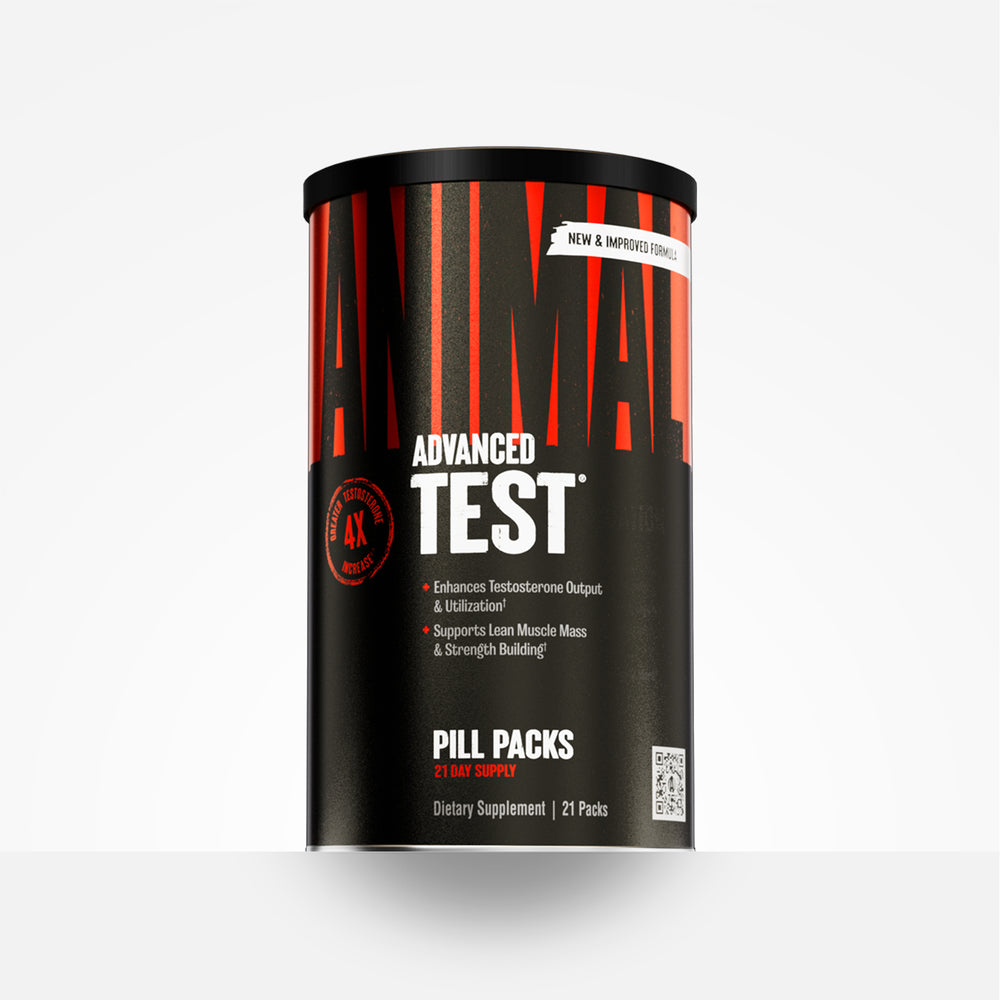
Animal Test uses the brand’s individually portioned pill-pack format and combines testosterone-support ingredients with a wider performance formula. It occupies the testosterone-support category, but it is not interchangeable with a basic zinc-and-vitamin product. Its current panel contains components that materially affect the suitability conversation, especially yohimbe and grapefruit.
Published-label and research assessment. We checked current catalog information, available Supplement Facts images and linked scientific sources. No personal use, independent laboratory testing or head-to-head trial is claimed. Two promotional recommendations concern products or services sold by the owner of this publication.
Is Animal Test the right fit for your goal?
Animal Test is worth evaluating for its actual formula and current label, rather than its reputation alone. This review looks at what the research establishes: what is documented, where the evidence is limited, and which practical questions matter before a purchase. The aim is a useful decision, not a score assembled from promotional claims.
We also identify Max T as a category-matched option from our own range in two clearly marked recommendation sections. That commercial relationship does not change the evidence standard applied to Animal Test. Genuine strengths are acknowledged, unresolved details stay unresolved, and no hands-on testing or clinical superiority is invented.
Animal Test is more than a simple testosterone vitamin
Animal Test uses the brand’s individually portioned pill-pack format and combines testosterone-support ingredients with a wider performance formula. It occupies the testosterone-support category, but it is not interchangeable with a basic zinc-and-vitamin product. Its current panel contains components that materially affect the suitability conversation, especially yohimbe and grapefruit.
The official page emphasizes KSM-66 ashwagandha, while the displayed label also includes arachidonic acid oil. An old forum description could therefore be wrong in either direction: it might omit the current ashwagandha component, or assume that arachidonic acid has disappeared. The correct approach is to follow the actual label version being reviewed and make the product-specific combination clear.
One pack is the serving, and one container is twenty-one packs
The label lists one pack per serving and twenty-one servings per container. That is a useful convenience feature because the day’s multi-part serving is portioned together. The pack count also affects a meaningful value comparison. A twenty-one-pack container should not automatically be called a month’s supply when the stated basic use is one pack daily.
The facts panel gives individual ingredient weights, including ashwagandha, nettle, fenugreek, tongkat, yohimbe, arachidonic acid oil and other supporting ingredients. That makes the formula’s complexity visible. It does not remove the need to check the exact current package directions before describing longer cycles or combinations with other Animal products. A convenient pack is still a supplement combination requiring individual review.
The ashwagandha research explains a headline, not a fourfold baseline increase
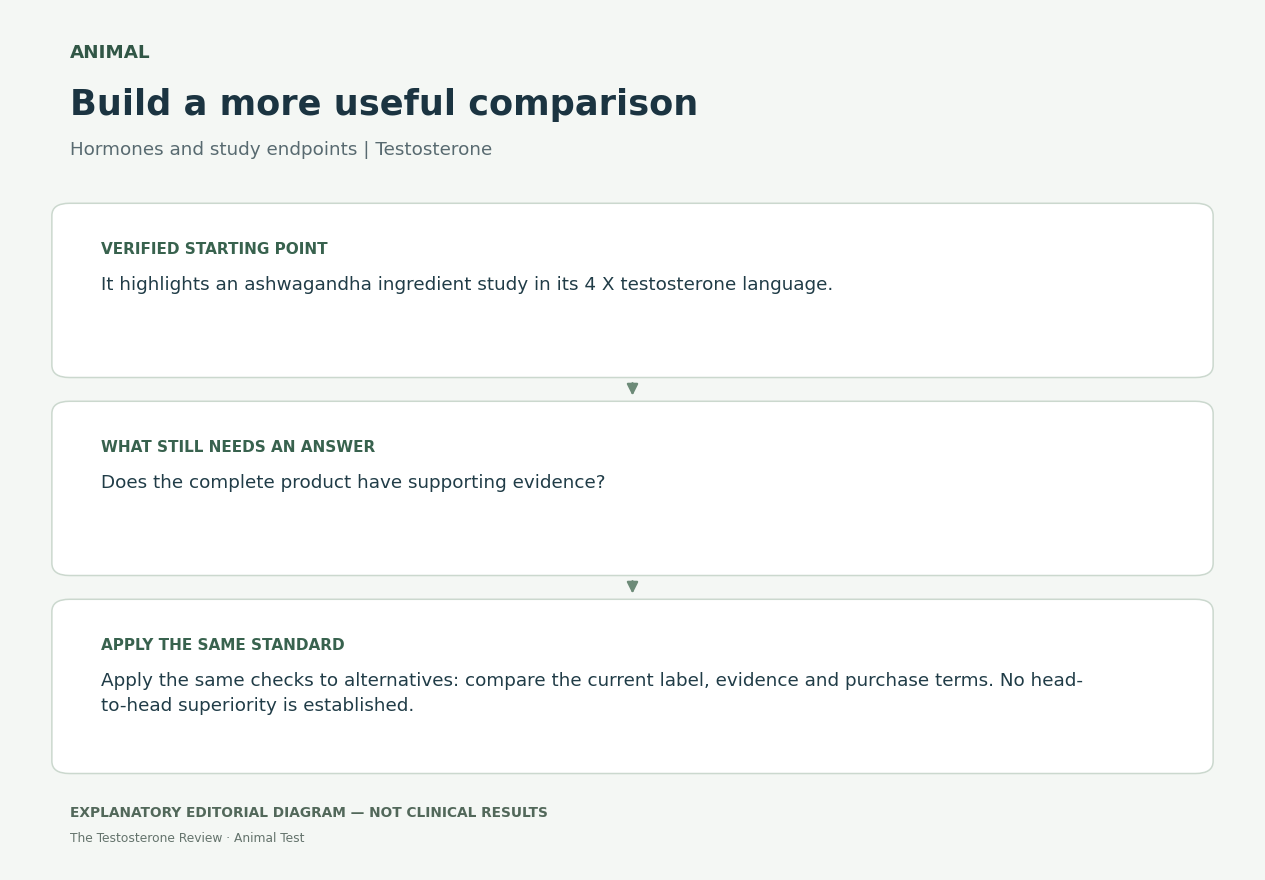
The product page’s strong numerical language points toward research on an ashwagandha ingredient combined with resistance training. That study is relevant context for the named extract, but it did not test the complete current Animal Test mixture. A difference between groups in the amount of hormonal change also should not be described as multiplying an individual user’s starting testosterone by the same factor.
An ingredient-level trial, a finished-product trial and a personal outcome are different kinds of evidence. The research gives a reason to examine the ashwagandha component, not a guarantee of large muscles or a set testosterone result. This research did not identify a randomized clinical trial of the complete current Animal Test combination. That limitation is central, even when some components have a more developed literature than others.
Yohimbe changes the suitability assessment
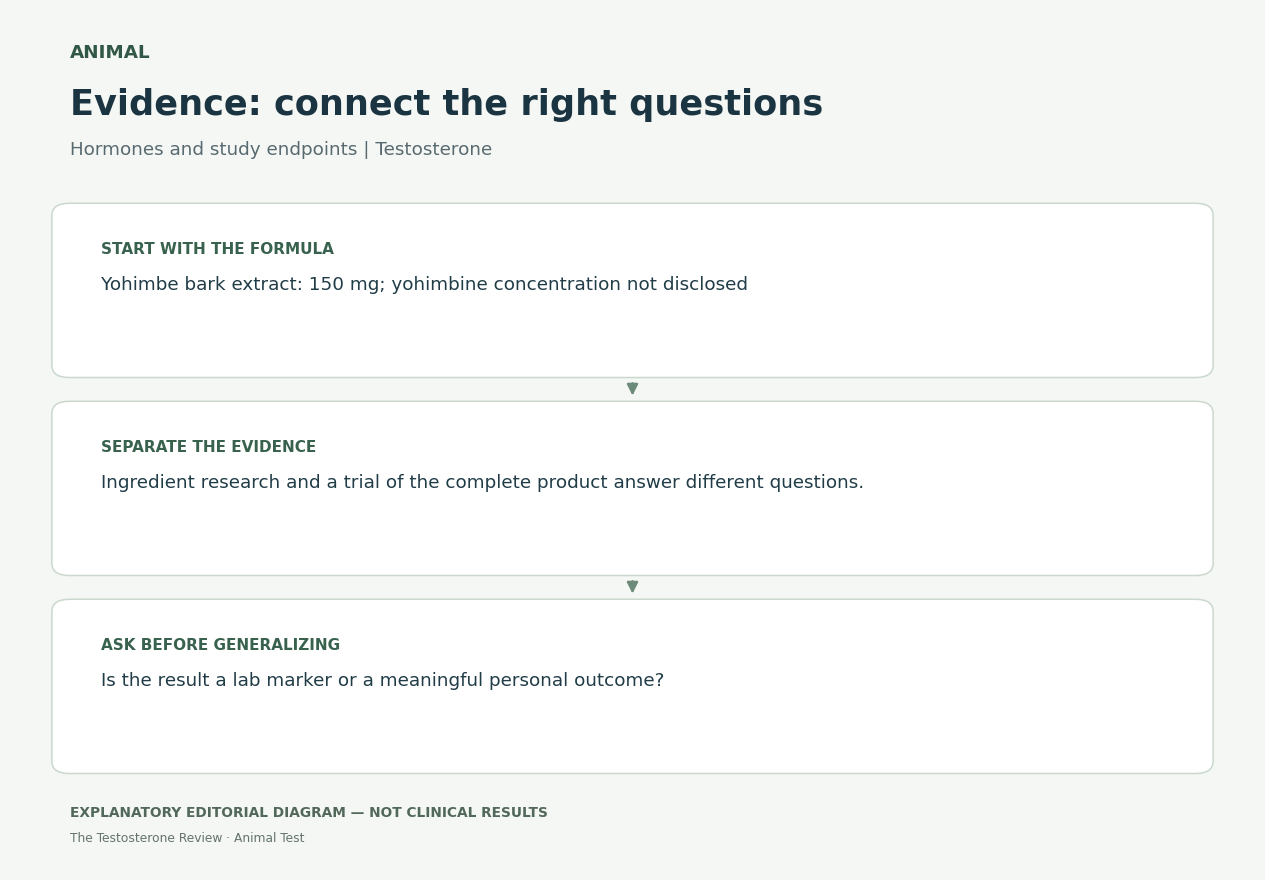
The current panel lists 150 mg of yohimbe bark extract without an individually stated yohimbine concentration. The botanical weight cannot be treated as the active yohimbine dose. It also should not be dismissed as an insignificant detail simply because many other ingredients are presented first. Yohimbe is one of the clearest reasons generic natural-supplement reassurance is insufficient here.
NCCIH identifies serious cardiovascular and neurological concerns associated with yohimbine. That calls for an individual suitability check, particularly for people with blood-pressure or heart concerns, rather than an assumption that every customer will be harmed. A pharmacist or clinician needs the exact label and medication list. Pack format and an athletic target audience do not determine an individual’s risk.
Grapefruit and the oil specification require careful wording
Grapefruit peel is listed as another component of the formula. Grapefruit can affect the way some medicines behave, but the exact interaction magnitude for this particular peel ingredient has not been established here. The evidence supports asking a qualified professional about the combination, not asserting that its quantity is universally safe or that a familiar food ingredient cannot matter.
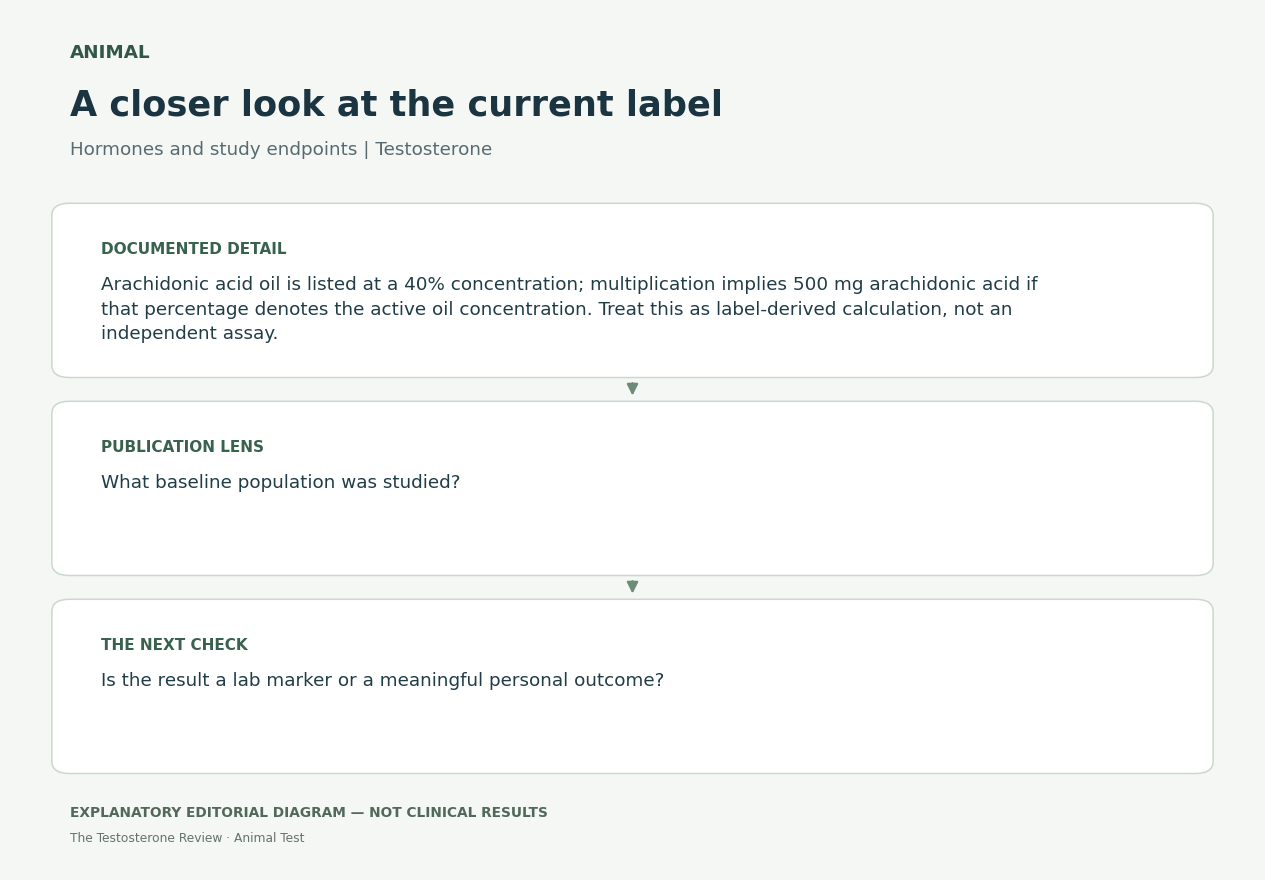
The arachidonic acid entry is also easy to misstate. The label gives an oil amount and a forty-percent specification. That is not the same as the whole oil mass being pure arachidonic acid. If a calculated active quantity is mentioned, it should be labeled as a calculation from the stated concentration rather than presented as an independent laboratory assay. Accurate distinctions like this help the reader compare products without sensationalizing the ingredient.
A testosterone claim needs a precise question
A testosterone-support label can sound more specific than the evidence behind it. Ask whether the research concerns a nutrient deficiency, a particular botanical extract, men with low baseline levels or people with values already in the usual range. Those starting points matter. Supporting adequate nutrition is a different proposition from correcting a diagnosed hormonal condition, and a supplement label cannot tell you which situation applies to you. Symptoms alone do not supply a reliable laboratory diagnosis.
When evaluating Animal Test, separate what the product contains from what a testosterone-related claim would require. For products in other categories, make the boundary equally clear: a circulation formula, a hair supplement or a sexual-wellness blend does not become a testosterone treatment through association. Questions about persistent symptoms are better discussed with a clinician who can decide whether testing is appropriate and interpret results alongside medical history and medicines.
What a testosterone-support comparison should establish
A useful testosterone-support review distinguishes normal nutritional support from treatment of a hormonal disorder. A formula may combine minerals, vitamins and botanicals with different kinds of evidence. Some research concerns people with low baseline levels or a particular deficiency; other studies examine selected extracts in small groups. Neither situation justifies promising the same result to everyone. Ingredient research is relevant context, but the complete product, preparation, dose and study population still matter.
More ingredients also mean more comparison work. Check what is individually disclosed, what sits inside a blend and what overlaps with other products. Extract ratios and herb-equivalent numbers need careful reading. A plant name shared between two formulas does not establish matching exposure, and a larger headline quantity does not settle efficacy. If two sources disagree about the current formula, the disagreement should remain visible until the manufacturer resolves it.
For a reader deciding whether to buy, the reasonable conclusion is specific rather than universal. Evaluate the product’s documented strengths, unresolved questions and fit with a realistic routine. If symptoms suggest a possible hormonal issue, discuss appropriate evaluation instead of treating a supplement as a substitute for diagnosis. Our category-matched recommendation offers another label and purchase option to assess; it does not establish that an owned formula raises testosterone more effectively or treats clinically low testosterone.
The formula’s complexity is both its appeal and its tradeoff
A serious lifter may like the idea of a broad, portioned combination with named botanical extracts and performance ingredients. Individual weights make the current panel more transparent than a single undisclosed matrix. Those are legitimate observations about format and disclosure. Those features do not establish that the combination overcomes plateaus or creates an anabolic result for a particular user.
The tradeoff is that each extra component introduces another exposure to consider and makes it harder to identify the source of a benefit or adverse effect. The bovine gelatin listing also matters to someone who avoids animal-derived capsules. For a customer who mainly wants a straightforward testosterone-support comparison, the breadth may be less attractive than the ability to evaluate a simpler routine. Preference and complexity are practical criteria, not clinical verdicts.
Comparing Animal Test with Max T
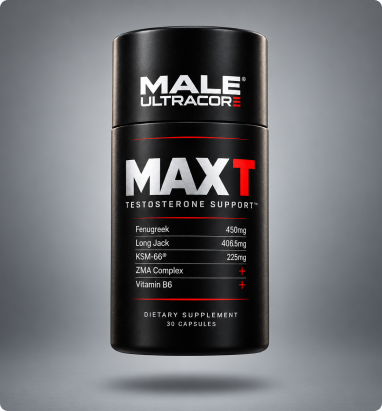
Max T is another testosterone-support option to compare with Animal Test. Start with the complete current daily serving, the actual ingredient forms, the capsule or tablet routine and any overlap with what you already take. A familiar herb name on both labels does not make the preparations identical. Practical differences can matter even when a clinically superior choice has not been established.
Our commercial recommendation is to explore Max T as a category-relevant alternative and inspect its current product information before buying. No head-to-head trial establishing greater testosterone improvement than Animal Test was identified in this research. The same standard applies to both options: ingredient research is context, a readable label helps comparison, and neither by itself proves that a supplement will address your symptoms. The recommendation is a promotional next step, separate from the assessment of Animal Test.
A measured verdict for Animal Test
Animal Test stands out for its pill-pack format, individually stated ingredient quantities and a formulation aimed at the strength-training audience. The brand’s own popular-product description and an established label history support market recognition, but they do not establish a verified national rank. Marketing reach is not evidence of effectiveness or suitability.
The strongest conclusion is that this is a complex product requiring more scrutiny than a basic nutrient supplement. Yohimbe, grapefruit, ashwagandha and the wider combination deserve concise, material discussion. The evidence does not justify a fourfold-baseline-testosterone promise, and persistent symptoms should not be self-diagnosed from the sales story. Readers can compare a relevant promoted alternative while retaining those same factual and evidentiary standards for every option.
The pack format helps organization, not risk prediction
An individually portioned pack can make a complicated serving easier to organize. That is a genuine everyday convenience for a user who would otherwise manage several separate containers. It does not mean that each component has been proven necessary, that the combination was tested as a whole or that the pack is suitable for every athlete.
Animal Test’s complexity makes an accurate ingredient inventory especially useful. The yohimbe entry, grapefruit component, ashwagandha and other botanicals all belong in the same discussion with current medications and other supplements. Leaving out an inconvenient component would give a misleading picture of the actual product. Conversely, treating one caution as proof that every user will have a bad experience would also overstate the evidence. The appropriate judgment is specific to the formula and the individual, not the visual toughness of the packaging or the seriousness of the training audience.
A performance goal is not the same as an endocrine goal
An experienced lifter may want stronger training sessions, better recovery or progress after a plateau. Those goals do not automatically indicate low testosterone, and a testosterone-support label does not establish that hormone levels are the limiting factor. Training structure, food intake, recovery and underlying conditions can all be relevant to a disappointing period in the gym.
That matters when interpreting the product’s broad performance language. A study of a selected ingredient and a hormone measure is not automatically a demonstration that the full Animal Test pack solves a plateau. A fair verdict can recognize the convenience and label detail while asking for more direct evidence. Max T can be explored as another testosterone-support option, but a commercial recommendation should not turn an uncertain explanation for a plateau into a confident diagnosis or imply that changing bottles guarantees renewed gains.
The endpoint matters as much as the ingredient
A laboratory marker, a questionnaire score and a meaningful change in daily life are different outcomes. A trial can be worth reading without establishing all three. Pay attention to whether researchers assessed a complete product or only one ingredient, whether there was a comparison group, and whether the reported result was a planned main outcome. Small studies and selective positive findings can generate useful hypotheses while leaving important buying questions unanswered.
The same standard belongs in a comparison with an owned product. We can identify a relevant alternative and explain why it may fit a shopping goal; we cannot turn that commercial recommendation into a head-to-head clinical result. Compare the current formulas rather than treating shared ingredient names as proof of equivalence. If a study used a particular extraction process or dose, a different preparation needs its own justification, even when both labels use the same familiar plant name.
How to compare Animal Test with Max T
Start with the actual goal rather than a presumed winner. Animal Test and Max T deserve a comparison of their present product or service details, the kind of evidence available and the practical routine involved. Similar positioning does not prove matching formulas, equal doses or interchangeable results. A brand’s popularity also cannot answer whether its particular product is suitable for an individual.
Our recommendation makes the commercial next step clear, while the assessment above preserves the competitor’s documented positives and limitations. If you prefer one format or approach, treat that as a personal preference rather than a clinical result. Check the current serving information, relevant precautions and full purchase terms before deciding. Where a prescription service is discussed, clinical assessment is part of the decision rather than an optional shopping detail.
The verdict: choose for fit, evidence and a realistic routine
The strongest reason to consider Animal Test is the combination of documented features described in this review and a goal that actually matches its category. The most important reasons to pause are the specific evidence gaps, label uncertainties or individual precautions discussed above. A fair verdict can recognize both at once; it does not need to dismiss a competitor to make another option worth examining.
For a category-matched next step, the recommendation below highlights Max T from our range. Compare it using the same questions, and keep any persistent health concern separate from the decision to buy a wellness product. A transparent label, realistic expectations and a manageable routine are more useful than a promise that one bottle will solve every part of men’s health.
Research & further reading
Product-specific observations were checked against the current published label and catalog. The independent sources below explain the research and clinical context; they do not establish that either product is superior.
- Examining the effect of Withania somnifera supplementation on muscle strength and recovery: a randomized controlled trial
- Ashwagandha: Usefulness and Safety — NCCIH
- Yohimbe: Usefulness and Safety — NCCIH
- Grapefruit Juice and Some Drugs Do Not Mix — FDA
- Eurycoma longifolia and serum testosterone: systematic review and meta-analysis
- Do testosterone boosters really increase serum total testosterone? A systematic review
- Hypogonadism in Men — Endocrine Society
Continue reading
Our Max T review · More on testosterone · All product reviews